MainSilhouetteArtboard 1
Artboard 1
Chateau Lafite_Axo_silhouette
Artboard 3
Artboard 1
Artboard 3
Ghent_Axo_silhouette
GL Pau_Axo_silhouette-01
EMVS_Axo_silhouette
Ministerio_Axo_silhouette
Hamburg_Axo_silhouette
Cafferata_Axo_silhouette
Halle bioclimatique_Axo_silouhette-small
Palenque_Axo_silhouette
Crystal Palace_Axo_silhouette
Carriego_Axo_silhouette
159 Dwellings in Carabanchel
Madrid, Spain
EMVS - Empresa Municipal de Vivienda y Suelo
Javier García Germán - TOTEM arquitectos
2018
22675 m²
New built
Collective housing
In construction

In the hot, dry, sunny summers of Madrid, the major challenge is to lower indoor temperatures. As the wind speed is fairly high, cross ventilation becomes a crucial tool to tackle the heat. However, often the buildings of social housing require a strict control on budget and achieving exposure on two orientations per unit becomes too expensive.
In this case, the cross ventilation of all units was ensured using a system of nozzles (wind corridors) that allows air to flow through the building (1). The location of the nozzles was optimised to create the maximum airflow in all the corridors. The internal façade of each featured openings that enabled air to flow from the external façade, creating a system of cross ventilation within the building (2). Common spaces had to be closed, and are more exposed to the sun, which is why they have their own ventilation system that ensures ventilation even on days without wind. A system of solar chimneys was devised for each one of the spaces, using the windows as air inlet and the chimneys as extraction (3).

Airflow in the central corridors

Air movement is perceived
feeling of -4ºC
nuisance
  • 0
  • 0.5
  • 1
  • 1.5
  • 2
  • 2.5
  • 3
  • 3.5
  • 4
  • 4.5
  • 5
m/s
Wind speed calculated at chest level

Airflow in units

air movement is perceived
  • 0
  • 0.2
  • 0.4
  • 0.6
  • 0.8
  • 1.0
  • 1.2
  • 1.4
  • 1.6
  • 1.8
  • 2.0
m/s
Wind speed is calculated at chest level

Airflow in common spaces and solar chimneys

air movement is perceived
  • 0
  • 0.2
  • 0.4
  • 0.6
  • 0.8
  • 1.0
  • 1.2
  • 1.4
  • 1.6
  • 1.8
  • 2.0
m/s

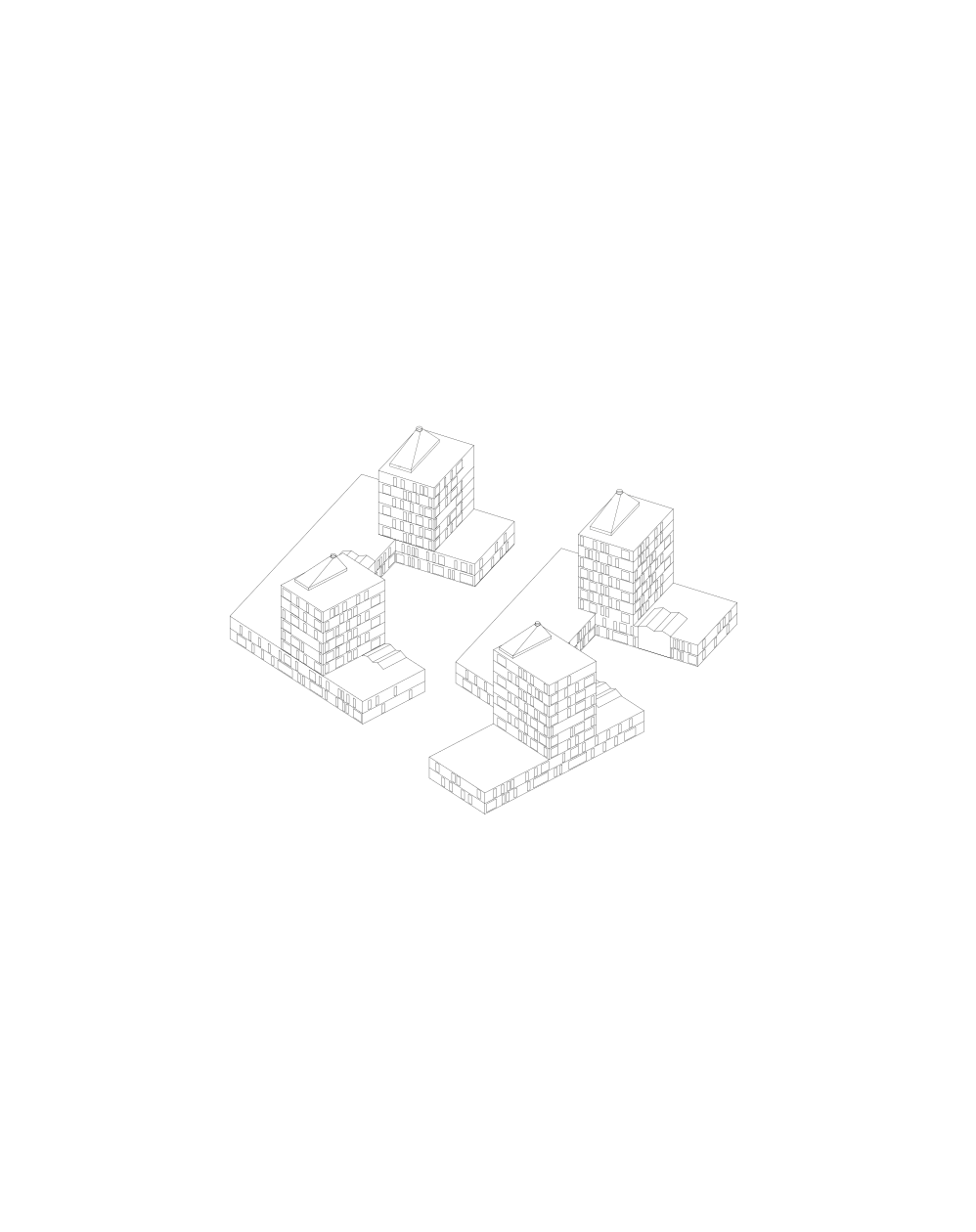
Buildings on the extension of Carabanchel, Madrid, are usually isolated constructions on private plots filled with greenery. However, this project proposes to invert this common practice, and build a public high quality space that enhances human interaction between neighbours and with their environment. Two buildings with broken geometries delimit three public spaces of varied characteristics, which serve as the pivot points for the social activity of the neighbourhood. These public spaces are laid out in different levels following the existing topography, to ensure accessibility from all the surrounding streets and give access to the four building entrances leading to the private units. In addition to external public areas, the project incorporates semi-interior spaces where neighbours can meet comfortably during winter.

Madrid’s climate is classified as Hot-summer Mediterranean climate [Csa] by Koppen Geiger. Winters are mild and relatively sunny, and temperatures seldom drop below freezing. Summers are hot and very sunny, with average temperatures of almost 30ºC during the day. Future climate will intensify the risk and duration of indoor overheating, as average summer temperatures are forecasted to increase by more than 5ºC. The sun plays a key role in the design of low energy housing in Madrid, both as an asset to heat up the units passively in winter and a threat that will make them overheat in summer. The abundant solar radiation during summer reaches all orientations between East to West which need to be protected, while during winter it does so on the facades facing southeast, south, and southwest, which benefit from passive solar heating. Prevailing winds blow from west southwest during 36% of the time, with an average speed of 2.3 m/s.

Climate summary

Average temperature
t
(°C)
Avg. min. and avg. max. temperature
t
(°C)
Relative humidity
w
(%)
Daily diffuse solar radiation
r
(100xW/m²)
Daily total solar radiation
r
(100xW/m²)
Wind speed
a
(m/s)
Monthly precipitations
w
cm
Daily range
t
(°C)
Temperature predictions for 2050
t
(°C)

Sun path

Solar altitude
s
  • 0
  • 240
  • 480
  • 720
  • 960
  • 1200
kWh/m2

Wind rose

Wind frequency
a
  • 0
  • 1
  • 2
  • 3
  • 4
  • 5
  • 6
  • 7
  • 8
  • 9
  • 10
m/s
Close